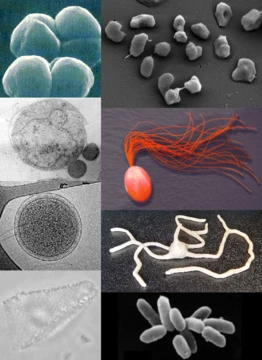
Pseudomonadota
A diverse phylum of gram-negative bacteria with pathogenic and free-living members.

Pseudomonadota (synonym Proteobacteria) is a major phylum of gram-negative bacteria that includes both pathogenic and free-living genera. The phylum comprises six widely recognized classes: Acidithiobacillia, Alphaproteobacteria, Betaproteobacteria, Deltaproteobacteria, Epsilonproteobacteria, and Gammaproteobacteria. Pseudomonadota are very diverse, with differences in morphology, metabolic processes, relevance to humans, and ecological influence.
- Number of classes
- 6
Lore & Background
This renaming remains controversial among microbiologists, many of whom continue to use the name Proteobacteria, which has a lot of precedent in the literature.
Reader's Guide
Pseudomonadota are significant due to their immense diversity and impact on human health, ecology, and industry. The phylum includes many pathogenic genera such as Escherichia, Salmonella, Vibrio, Yersinia, and Legionella, which cause major diseases. At the same time, free-living members are crucial for nitrogen fixation and nutrient cycling. The classes exhibit varied metabolisms: Acidithiobacillia assist in bioleaching for mining, Alphaproteobacteria include ancestors of mitochondria, Betaproteobacteria contain chemolithoautotrophs and opportunistic pathogens, Gammaproteobacteria are one of the largest classes with biodegradation capabilities, Hydrogenophilalia are used to remove sulfides from wastewater, and Zetaproteobacteria are iron-oxidizing chemolithoautotrophs in marine habitats. The phylum also serves as a marker for gut microbiome instability in human health. Natural genetic transformation occurs in at least 30 species, aiding DNA repair in pathogens. The reclassification of Deltaproteobacteria and Epsilonproteobacteria out of the phylum remains debated, reflecting ongoing taxonomic uncertainty.
Did You Know?
- The name Proteobacteria comes from the Greek god Proteus, who could change shape.
- The class Epsilonproteobacteria was proposed for reclassification as Campylobacterota in 2017.
Frequently Asked Questions
Who is Pseudomonadota?
Pseudomonadota is a major phylum of gram-negative bacteria, also widely known by its older synonym Proteobacteria. It groups together both disease-causing genera and free-living organisms that occupy a huge range of habitats.
What are Pseudomonadota's powers or ecological role?
Members of this phylum show remarkable metabolic versatility, carrying out processes such as nitrogen fixation, sulfur oxidation, and varied carbon cycling. Their ecological footprint stretches across soils, aquatic systems, and host-associated niches.
How does Pseudomonadota's story end in the series?
Because Pseudomonadota is a foundational phylum rather than a single character, it has no narrative finale; its members remain active participants in biogeochemical cycles and human health. The phylum's persistent presence in virtually every microbial community keeps its 'storyline' perpetually ongoing.
Why is Pseudomonadota important to fans and to biology?
The phylum houses well-known pathogens alongside ecologically critical free-living bacteria, making it central to both medical microbiology and environmental science. Its six recognized classes cover an enormous spread of morphologies and metabolic strategies, which is why it dominates so many discussion threads.
What are Pseudomonadota's six classes?
The phylum is divided into Acidithiobacillia, Alphaproteobacteria, Betaproteobacteria, Deltaproteobacteria, Epsilonproteobacteria, and Gammaproteobacteria. Each class clusters genera with shared traits while still contributing to the phylum's overall metabolic and ecological diversity.
More in Microbial Groups And Extremophiles 1-17
Spotted an error? Know more?
This is a living reference — every entry is fact-audited, and reader corrections feed straight into our audit queue. Suggest an edit · See this site's audit record