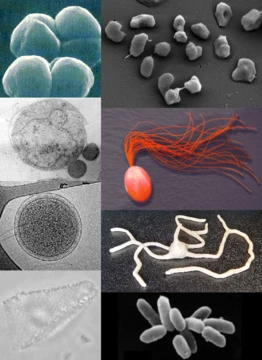
SAR supergroup
A major eukaryotic supergroup uniting stramenopiles, alveolates, and rhizarians.

The SAR supergroup is a highly diverse clade of eukaryotes, often considered a supergroup, that includes stramenopiles (heterokonts), alveolates, and rhizarians. It is a node-based taxon comprising all descendants of the last common ancestor of these three groups and comprises most of the now-rejected Chromalveolata. The name SAR is an acronym derived from the first letters of its three constituent clades, alternatively spelled RAS, and the term Harosa has also been used at the subkingdom level.
- field
- Eukaryotic phylogenetics
- known_for
- Uniting stramenopiles, alveolates, and rhizarians into a major eukaryotic supergroup
- comprises
- Stramenopiles, Alveolata, Rhizaria
- sister_group
- Possibly telonemids (TSAR clade, challenged)
- estimated_diversity
- Up to half of all eukaryotic diversity
Lore & Background
Before the discovery of the SAR supergroup, stramenopiles and alveolates were classified in the supergroup Chromalveolata alongside haptophytes and cryptomonads, believed to have acquired plastids through secondary endosymbiosis of red algae via a common ancestor. Rhizaria was traditionally considered a separate supergroup. More recent phylogenetic studies confirmed that stramenopiles and alveolates diverged with rhizarians as part of the SAR lineage, and later phylogenomic studies found this clade to be robustly characterized compared to other supergroups. This group excludes haptophytes and cryptomonads, hypothesized to have acquired plastids in separate endosymbiosis events, leading to the proposal of the clade Hacrobia to accommodate them.
Reader's Guide
The SAR supergroup encompasses a vast variety of morphologies and ecological niches, from microscopic zoo- and phytoplankton to massive kelp forests. It includes both photosynthetic and non-photosynthetic forms. Photosynthesis arose independently across various stramenopile and alveolate lineages through secondary or higher-order endosymbiosis events, acquiring plastids of red algal origin, while chlorarachniophyte rhizarians captured plastids from green algae, retaining vestigial nucleomorphs. It has been estimated that SAR encompasses up to half of all eukaryotic diversity. Owing to the clade's discovery through phylogenomics, there are no known synapomorphies uniting its various members, though Stramenopiles is well-defined morphologically by an anterior flagellum with tripartite bristles, and Alveolata by cortical alveoli. Studies of telonemids have revealed characteristics potentially homologous to structures in stramenopiles and alveolates, suggesting these structures might be ancestrally shared.
Did You Know?
- The name SAR is an acronym from Stramenopiles, Alveolata, and Rhizaria, and has been alternatively spelled RAS.
- The SAR supergroup comprises most of the now-rejected Chromalveolata.
- It has been estimated that SAR encompasses up to half of all eukaryotic diversity.
- No known synapomorphies unite the SAR supergroup; it was discovered through phylogenomics.
Composition and Morphological Range
SAR encompasses three major lineages—Stramenopiles, Alveolata, and Rhizaria—that together represent an extraordinary spectrum of eukaryotic form. Stramenopiles and Alveolata are predominantly flagellated organisms, yet they span from photosynthetic diatoms, brown algae, and dinoflagellates to devastating parasites such as oomycetes and apicomplexans. Rhizaria, by contrast, harbors the bulk of amoeboid protists, including testate amoebae, foraminifers, and radiolarians. Despite this morphological gulf between flagellates and amoebae, molecular phylogenetics placed them into a single supergroup, revealing evolutionary connections invisible to morphology alone. The group also includes several independent transitions to multicellularity, with some members producing colonies bearing alternating cell types or even seaweeds with differentiated tissues. The comparatively low number of formally described species belies the true breadth of SAR diversity, as environmental DNA surveys indicate that most remain unknown to science. This range, from microscopic single cells to complex multicellular forms, makes SAR one of the most morphologically heterogeneous assemblages in the eukaryotic tree.
Ecological Roles and Global Impact
Members of SAR occupy nearly every trophic niche in aquatic and terrestrial ecosystems. As phototrophs, diatoms, brown algae, and dinoflagellates contribute a substantial share of global primary production and carbon fixation, anchoring food webs across oceanic and coastal environments. At the same time, free-living SAR protists can trigger harmful algal blooms that devastate aquatic life. On the consumer side, oomycetes and apicomplexans have evolved into major parasites: the former cause significant plant diseases such as potato blight and clubroot, while the latter are responsible for human and animal illnesses including malaria and toxoplasmosis. SAR organisms also participate in mutualistic partnerships with corals and termites, and they regulate bacterial and fungal populations while releasing nutrients back into trophic webs. Their presence spans even extreme habitats, underscoring their role as foundational components of biogeochemical cycling across the planet.
Redefining Classification Through Molecular Evidence
Before the rise of molecular phylogenetics and electron microscopy, organisms now assigned to SAR were scattered across the old kingdom Protista or lumped as algae and protozoa within the traditional plant and animal kingdoms. Genetic analysis shattered these convenience-based groupings: algae turned out to be intermixed with protozoa, and some forms once considered unrelated proved to be close evolutionary relatives. The supergroup framework that emerged from these studies reorganized Stramenopiles, Alveolata, and Rhizaria into a coherent clade despite their superficially disparate appearances. This revision was part of a broader upheaval in protist taxonomy, where seemingly unrelated forms were found to share deep ancestry and vice versa. The result is that SAR, like other supergroups, contains a patchwork of phototrophs, heterotrophs, and mixotrophs united by their shared position on the eukaryotic tree of life rather than by any single morphological trait visible to the naked eye.
Cellular Architecture and Life-Cycle Complexity
SAR protists share a conserved flagellar apparatus with basal bodies from which microtubules radiate, scaffolding the rest of the cell. Beyond this common cytoskeletal framework, the group displays an astonishing variety of nutritional strategies: phagotrophy, osmotrophy, myzocytosis, and phototrophy via chloroplasts, often combined in a single organism as mixotrophy. Mitochondrial modifications further diversify their respiratory biochemistry. Many SAR cells harbor unique organelles—contractile vacuoles maintaining osmotic homeostasis, eyespots for light detection—and tend to host bacterial and archaeal symbionts that bolster their metabolism and nutrition. Contrary to the long-held assumption of strictly asexual reproduction, SAR members are capable of sexual reproduction and can cycle through complex life stages involving alternating generations. The full scope of their cellular and reproductive innovation remains only partially catalogued, with most species still awaiting formal description.
Frequently Asked Questions
What is the SAR supergroup?
The SAR supergroup is a major eukaryotic clade that unites three distinct lineages—stramenopiles, alveolates, and rhizarians—under a single evolutionary node. It encompasses all descendants of the last common ancestor shared by those three groups.
What are the three main groups within the SAR supergroup?
The three constituent clades are stramenopiles (also called heterokonts), alveolates, and rhizarians. Together they span an enormous range of ecological roles, from diatoms and kelp to dinoflagellates, ciliates, and foraminiferans.
How did the SAR supergroup get its name?
The name is simply an acronym built from the first letters of its three member clades: Stramenopiles, Alveolata, and Rhizaria. You may also encounter the alternate spelling RAS, and at the subkingdom level the term Harosa has been used as a synonym.
How large is the SAR supergroup in terms of biodiversity?
Estimates suggest the SAR supergroup encompasses up to half of all known eukaryotic diversity, making it one of the most species-rich assemblages in the tree of life. This staggering breadth is a major reason it is treated as a supergroup rather than a simple phylum.
What is the SAR supergroup's connection to the old Chromalveolata hypothesis?
Most of the organisms once lumped together under the now-rejected Chromalveolata concept fall within the SAR supergroup. Modern phylogenetics has reorganized that grouping, but SAR retains the core idea of a deep evolutionary link among heterokonts, alveolates, and rhizarians.
More in Microbial Groups And Extremophiles 1-17
Spotted an error? Know more?
This is a living reference — every entry is fact-audited, and reader corrections feed straight into our audit queue. Suggest an edit · See this site's audit record