Rhizaria
Diverse clade of mostly unicellular amoeboid eukaryotes.

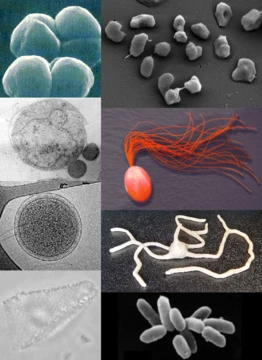
The Rhizaria are a diverse and species-rich clade of mostly unicellular eukaryotes. Except for the chlorarachniophytes and three species in the genus Paulinella in the phylum Cercozoa, they are all non-photosynthetic, but many Foraminifera and Radiolaria have a symbiotic relationship with unicellular algae. A multicellular form, Guttulinopsis vulgaris, a cellular slime mold, has been described. This group was used by Cavalier-Smith in 2002, although the term 'Rhizaria' had been long used for clades within the currently recognized taxon. Being described mainly from rDNA sequences, they vary considerably in form, having no clear morphological distinctive characters (synapomorphies), but for the most part they are amoeboids with filose, reticulose, or microtubule-supported pseudopods.
- field
- Protistology, Eukaryotic Phylogenetics
- known_for
- Diverse clade of amoeboid eukaryotes with filose, reticulose, or axopodial pseudopods; includes Foraminifera and Radiolaria
- key_taxon
- Rhizaria
- described_by
- Cavalier-Smith (2002)
- major_groups
- Cercozoa, Foraminifera, Radiolaria
Lore & Background
The Rhizaria are a group whose similarities between various organisms have been noticed since the 19th century. Carpenter proposed the order Reticularia, which consisted of Foraminifera and Gromiida on the basis of their very similar thin, reticulose pseudopodia with granules circulating inside. However, the idea that these organisms and others such as Radiolaria were all related to one another emerged rather recently, with the help of molecular phylogenetics and advanced microscopy techniques in the late 20th century. The name Rhizaria for the expanded group was introduced by Cavalier-Smith in 2002, who also included the centrohelids and Apusozoa.
Reader's Guide
Historically, many rhizarians were considered animals because of their motility and heterotrophy, but later placed in the kingdom Protista, which was recognized as paraphyletic. Rhizaria appear to share a common ancestor with Stramenopiles and Alveolates, and molecular phylogenetic studies support Rhizaria as a monophyletic group. Their ecological importance is notable: forms symbiotic with unicellular algae contribute significantly to total primary production of the ocean. Certain species can attain sizes of more than a centimeter, with some forming cylindrical colonies approximately 1 cm in diameter and greater than 1 m in length. Biosynthesis of 24-isopropyl cholestane precursors in various rhizaria suggests a relevant ecological role already during the Ediacaran. The group includes parasites such as Mikrocytos mackini, causative agent of Denman Island Disease in oysters. Complete sexual life cycles have been demonstrated for Foraminifera and Gromia, and direct evidence for karyogamy or meiosis has been observed in five lineages.
Did You Know?
- Except for chlorarachniophytes and three Paulinella species, all Rhizaria are non-photosynthetic, but many Foraminifera and Radiolaria have symbiotic relationships with unicellular algae.
- A multicellular form, Guttulinopsis vulgaris, a cellular slime mold, has been described within Rhizaria.
- Some Rhizaria possess mineral exoskeletons made of opal (SiO2), celestite (SrSO4), or calcite (CaCO3).
- The causative agent of Denman Island Disease, Mikrocytos mackini, is a small (2–3 μm diameter) amitochondriate protistan belonging to the order Mikrocytida within Ascetosporea.
Frequently Asked Questions
What is Rhizaria?
Rhizaria is a broad clade of predominantly single-celled eukaryotic organisms that move and feed using thread-like, net-like, or spine-like pseudopods. It groups together several major lineages of amoeboid protists under one evolutionary umbrella.
What are the major groups within Rhizaria?
The clade is organized into three principal lineages: Cercozoa, Foraminifera, and Radiolaria. Cercozoa contains the only photosynthetic members (chlorarachniophytes and a few Paulinella species), while the other two are non-photosynthetic but often host symbiotic algae.
Who established Rhizaria as a formal taxonomic name?
Thomas Cavalier-Smith formally applied the name Rhizaria to this clade in 2002, though the term had been used informally for smaller subgroups well before that. The grouping was largely built from ribosomal DNA sequence data rather than morphology alone.
Are Rhizaria photosynthetic?
Almost all members are non-photosynthetic, with the sole exceptions being the chlorarachniophytes and three Paulinella species within Cercozoa. Many Foraminifera and Radiolaria compensate by maintaining endosymbiotic relationships with unicellular algae for their carbon needs.
What pseudopod types characterize Rhizaria?
Members of this clade display three main pseudopod morphologies: filose (thin, thread-like), reticulose (net-like), and axopodial (stiff, spine-like). These structures are used for locomotion, prey capture, and in some cases for building intricate mineral tests.
More in Microbial Groups And Extremophiles 1-17
Spotted an error? Know more?
This is a living reference — every entry is fact-audited, and reader corrections feed straight into our audit queue. Suggest an edit · See this site's audit record