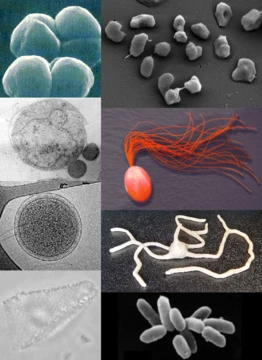
Stramenopile
Protists defined by tripartite stiff hairs, including brown algae and diatoms.

Stramenopiles, also called heterokonts, are a diverse group of protists distinguished by the presence of stiff tripartite external hairs. They represent one of the three major clades in the SAR supergroup, along with Alveolata and Rhizaria. Most stramenopiles are single-celled, but some are multicellular, including large seaweeds such as brown algae. The group includes algal protists, heterotrophic flagellates, opalines, proteromonad flagellates, actinophryid Heliozoa, and oomycetes. Many stramenopiles are significant as autotrophs and heterotrophs in natural ecosystems, and some are parasitic.
- field
- Protistology
- known_for
- Possession of tripartite stiff external hairs (mastigonemes) as a defining apomorphy
- clade
- SAR supergroup
- includes
- Brown algae, diatoms, oomycetes, opalines, actinophryid Heliozoa
Lore & Background
The term 'stramenopile' was introduced by D. J. Several alternative names have been proposed, such as Straminipila, Straminopiles, and Stramenopila, the latter being valid under the PhyloCode. The group's defining characteristic is the presence of tripartite flagellar hairs, though these have been secondarily lost in some taxa, such as most diatoms.
Reader's Guide
The stramenopiles are significant because they include some of the most important primary producers on Earth, such as diatoms and brown algae, which are major contributors to global carbon cycles and marine ecosystems. Diatoms are among the most significant autotrophs in marine and freshwater habitats, while brown algae like wrack and kelp dominate intertidal and subtidal zones. The group also includes important parasites, such as oomycetes that cause potato blight (Phytophthora infestans) and Blastocystis, a gastrointestinal parasite of humans. The term 'heterokont' had become ambiguous due to varied historical usage, leading to the 'heterokont problem', which was resolved by defining the stramenopiles as a clade based on the apomorphy of tripartite hairs. Molecular studies confirm that the genes coding for these hairs are exclusive to stramenopiles, even in taxa that have lost the hairs. The group arose as heterotrophs, with some lineages later acquiring plastids through endosymbiosis.
Did You Know?
- Most flagellated heterokonts have two flagella: an anterior one with stiff hairs and a smooth posterior one.
- Diatoms, which lack tripartite hairs, are still considered stramenopiles due to genetic similarity.
- The sister group to SAR, Telonemia, exhibits heterokont flagella with tripartite mastigonemes.
Frequently Asked Questions
Who is Stramenopile?
Stramenopile is a large, highly diverse clade of protists (also called heterokonts) that ranges from microscopic single cells to towering brown seaweeds. It forms one of the three core lineages of the SAR supergroup, sitting alongside Alveolata and Rhizaria.
What is Stramenopile's defining trait?
The group is unified by the presence of stiff, tripartite external hairs known as mastigonemes, a structural feature found in no other protist lineage. This apomorphy is the single characteristic that ties all its varied members together into one clade.
What are Stramenopile's most famous members?
Well-known representatives include brown algae, diatoms, and oomycetes, while less familiar groups such as opalines, proteromonad flagellates, and actinophryid Heliozoa also fall under the banner. The clade spans photosynthetic autotrophs, heterotrophic flagellates, and parasitic species.
What is Stramenopile's role in natural ecosystems?
Many stramenopile species act as primary producers or decomposers, anchoring food webs in marine and freshwater habitats. Others function as parasites, and together these ecological roles make the group a keystone component of global biogeochemical cycles.
Why is Stramenopile important to protistology?
Its tripartite mastigonemes provide a clear, inherited marker that lets researchers trace evolutionary relationships across the entire SAR supergroup. The sheer breadth of its diversity, from single-celled diatoms to giant kelp forests, makes it a central and endlessly rich subject of study.
More in Microbial Groups And Extremophiles 1-17
Spotted an error? Know more?
This is a living reference — every entry is fact-audited, and reader corrections feed straight into our audit queue. Suggest an edit · See this site's audit record