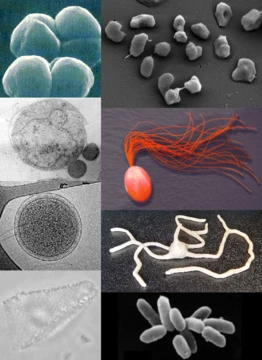
Thermoproteati
Kingdom of archaea sister to the eukaryote lineage.

Thermoproteati is a kingdom of archaea, also known by the acronym 'TACK,' which stands for Thaumarchaeota (now Nitrososphaerota), Aigarchaeota, Crenarchaeota (now Thermoproteota), and Korarchaeota. This group is found in diverse environments ranging from acidophilic thermophiles to mesophiles and psychrophiles, with predominantly anaerobic and chemosynthetic metabolisms. Thermoproteati is sister to the 'Asgard' branch that gave rise to eukaryotes, making it significant for understanding the origin of complex life.
- field
- Archaeal taxonomy and phylogeny
- known_for
- Sister kingdom to the Asgard branch that gave rise to eukaryotes; includes the eocyte hypothesis
- synonym
- TACK
- validly_published_name
- Thermoproteati (Guy and Ettema 2024)
Lore & Background
Thermoproteati encompasses several phyla, including Aigarchaeota, a phylum proposed from the genome of the candidate species 'Candidatus Caldiarchaeum subterraneum' found deep within a gold mine in Japan. Genomic sequences of this group have also been found in geothermal environments, both terrestrial and marine. Another phylum, Nezhaarchaeota, was discovered in Jinze Hot Spring, Yunnan, China. The best-known edge is Thermoproteota (formerly Crenarchaeota), the most abundant archaea in the marine ecosystem, previously called sulfobacteria due to their dependence on sulfur and important as carbon fixers.
Reader's Guide
Thermoproteati holds a pivotal role in evolutionary biology due to its proposed relationship with eukaryotes. The eocyte hypothesis, proposed in the 1980s by James Lake, suggests that eukaryotes emerged within the prokaryotic eocytes, a group now encompassed by Thermoproteati. One piece of evidence supporting a close relationship between Thermoproteati and eukaryotes is the presence of a homolog of the RNA polymerase subunit Rbp-8 in Thermoproteota but not in 'Euryarchaea.' This suggests that key molecular machinery linking archaea to eukaryotes originated within this kingdom. The classification of Thermoproteati has been subject to revision; it has been proposed that the kingdom be classified as 'Crenarchaeota' and that the traditional Crenarchaeota (Thermoproteota) be reclassified as a class called Sulfolobia, along with other phyla with class rank or order. After including the kingdom category into the International Code of Nomenclature of Prokaryotes (ICNP), the only validly published name of this group is kingdom Thermoproteati (Guy and Ettema 2024). Its members occupy a wide range of ecological niches, from hyperthermophiles in hydrothermal vents to mesophiles and psychrophiles, and are predominantly anaerobic and chemosynthetic, making them key players in global biogeochemical cycles.
Did You Know?
- Thermoproteati is also known by the acronym 'TACK,' which stands for Thaumarchaeota, Aigarchaeota, Crenarchaeota, and Korarchaeota.
- The phylum Aigarchaeota was proposed from the genome of a candidate species found deep within a gold mine in Japan.
- Thermoproteota (formerly Crenarchaeota) is the most abundant archaea in the marine ecosystem and were previously called sulfobacteria.
- A homolog of the RNA polymerase subunit Rbp-8 is present in Thermoproteota but not in 'Euryarchaea,' supporting a close relationship with eukaryotes.
Frequently Asked Questions
What exactly is Thermoproteati?
Thermoproteati is a formally recognized kingdom within the domain Archaea that unites several archaeal lineages under a single higher taxon. It is also widely known by the shorthand acronym TACK.
What does the TACK acronym break down into?
TACK is a mnemonic built from the first letters of four archaeal phyla: Thaumarchaeota (now reclassified as Nitrososphaerota), Aigarchaeota, Crenarchaeota (now Thermoproteota), and Korarchaeota. Together these lineages constitute the kingdom Thermoproteati.
How does Thermoproteati connect to the origin of eukaryotes?
Thermoproteati is the sister group to the Asgard archaea, the lineage from which eukaryotic cells ultimately emerged. This close phylogenetic position makes the kingdom central to the eocyte hypothesis and to reconstructing how complex cellular life first arose.
Who validly published the name Thermoproteati and when?
The kingdom name Thermoproteati was validly published by Guy and Ettema in 2024, giving the TACK clade a formal rank in archaeal taxonomy and phylogeny.
What kinds of habitats and metabolisms do Thermoproteati members show?
Members span an enormous ecological range, from acid-loving thermophiles to cold-adapted psychrophiles and moderate-temperature mesophiles. Their metabolisms are predominantly anaerobic and chemosynthetic, meaning they harvest energy from chemical reactions rather than from light or dissolved oxygen.
More in Microbial Groups And Extremophiles 1-17
Spotted an error? Know more?
This is a living reference — every entry is fact-audited, and reader corrections feed straight into our audit queue. Suggest an edit · See this site's audit record