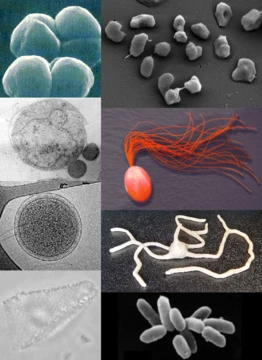
Thermoproteota
Thermoproteota are archaea from hot springs to open oceans.

The Thermoproteota are a phylum of archaea, initially thought to be sulfur-dependent extremophiles but later found to be abundant in marine environments. They were originally separated from other archaea based on rRNA sequences and lack of histones, though some members have histones. Recent evidence shows some are methanogens.
- Classification
- Phylum of Archaea
- Key feature
- Initially sulfur-dependent extremophiles; now known as abundant marine archaea
- Morphology
- Rod, cocci, filamentous, oddly-shaped cells; Gram negative
- Notable member
- Sulfolobus solfataricus (model hyperthermophile)
Lore & Background
The term 'eocyte' now applies to either TACK (formerly Crenarchaeota) or to Thermoproteota. One of the best characterized members is Sulfolobus solfataricus, isolated from geothermally heated sulfuric springs in Italy, growing at 80 °C and pH 2–4. Unlike most cultured thermophiles, it grows aerobically and chemoorganotrophically, making it a model organism for hyperthermophile research and the study of diverse viruses.
Reader's Guide
Thermoproteota are significant for reshaping views on archaeal ecology and evolution. Initially seen as obscure extremophiles, they are now recognized as possibly the most abundant archaea in marine environments, based on environmental rRNA and lipid analyses. Their discovery in soil and freshwater suggests ubiquity. This positions Thermoproteota as key to understanding the origin of eukaryotes, though the topic remains debated. Their study also revealed ultraviolet light-induced DNA transfer in Sulfolobus, a primitive form of sexual interaction that promotes chromosome integrity via recombinational repair.
Did You Know?
- Thermoproteota were initially thought to be sulfur-dependent extremophiles but are now considered the most abundant archaea in marine environments.
- Sulfolobus solfataricus, a model Thermoproteota, grows at 80 °C and pH 2–4 and was isolated from Italian sulfuric springs.
- Ultraviolet light induces type IV pili in Sulfolobus solfataricus, promoting cellular aggregation and high-frequency DNA exchange.
- The first cultured low-temperature Thermoproteota, Nitrosopumilus maritimus, is an ammonia-oxidizing organism grown at 28 °C.
Frequently Asked Questions
How does Thermoproteota's story end?
There is no final chapter yet; the phylum's profile keeps expanding as new cultured and uncultured members are described. What was once a narrow set of thermophilic, sulfur-reducing archaea now encompasses a much broader and more ecologically diverse group, so the narrative is still being written.
Why is Thermoproteota important?
As one of the most abundant archaeal lineages in the global ocean, Thermoproteota plays a significant role in marine carbon and nitrogen cycling. Model hyperthermophiles like Sulfolobus solfataricus also serve as essential laboratory tools for probing the biochemical limits of life.
What does Thermoproteota look like?
Members of this phylum are notably morphologically diverse, appearing as rods, cocci, filaments, or irregularly shaped cells, and they all take up the Gram-negative stain. This shape variety stands in contrast to the more uniform morphology typical of many bacterial phyla.
More in Microbial Groups And Extremophiles 1-17
Spotted an error? Know more?
This is a living reference — every entry is fact-audited, and reader corrections feed straight into our audit queue. Suggest an edit · See this site's audit record