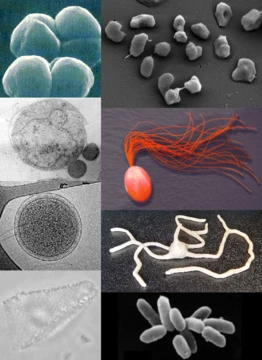
Thermus aquaticus
Thermophilic bacterium that enabled the polymerase chain reaction.

Thermus aquaticus (Latin for 'hot water') is a species of thermophilic bacteria that can tolerate high temperatures, belonging to the Deinococcota phylum. It is the source of the heat-resistant enzyme Taq DNA polymerase, one of the most important enzymes in molecular biology because of its use in the polymerase chain reaction (PCR) DNA amplification technique.
- field
- Microbiology, Molecular Biology
- known_for
- Source of Taq DNA polymerase, enabling PCR
- discovered_by
- Thomas D. Brock and Hudson Freeze
- type
- Thermophilic bacterium
Lore & Background
When studies of biological organisms in hot springs began in the 1960s, scientists thought that the life of thermophilic bacteria could not be sustained in temperatures above about 55 °C. Soon, however, it was discovered that many bacteria in different springs not only survived, but also thrived in higher temperatures. Brock and Hudson Freeze of Indiana University reported a new species of thermophilic bacteria which they named Thermus aquaticus. The bacterium was first isolated from Mushroom Spring in the Lower Geyser Basin of Yellowstone National Park, which is near the major Great Fountain Geyser and White Dome Geyser, and has since been found in similar thermal habitats around the world. T. aquaticus shows best growth at 65–70 °C, but can survive at temperatures of 50–80 °C. It primarily scavenges for protein from its environment, as evidenced by the large number of extracellular and intracellular proteases and peptidases. This bacterium is a chemotroph—it performs chemosynthesis to obtain food. However, since its range of temperature overlaps somewhat with that of photosynthetic cyanobacteria, it is sometimes found living jointly with its neighbors, obtaining energy for growth from their photosynthesis. The genetic material of T. aquaticus consists of one chromosome and four plasmids, and its complete genome sequencing revealed that it contains two full and two partial prophages, as well as numerous CRISPR loci.
Reader's Guide
PCR facilitated advancements in medical diagnostics, genetics, and other fields. The heat-resistant Taq DNA polymerase, isolated from T. aquaticus, eliminated the need to add E. coli polymerase enzymes after every cycle of thermal denaturation of the DNA. The commercial use of enzymes from T. aquaticus has not been without controversy. After Brock's studies, samples of the organism were deposited in the American Type Culture Collection, a public repository. As the commercial potential of Taq polymerase became apparent in the 1990s, the National Park Service labeled its use as the 'Great Taq Rip-off'. Researchers working in National Parks are now required to sign 'benefits sharing' agreements that would send a portion of later profits back to the Park Service. Overall, Brock's initial discovery in Yellowstone's hot springs paved the way for significant scientific breakthroughs, demonstrating the importance of basic research in driving innovation and technological advancements.
Did You Know?
- The bacterium can survive at temperatures of 50–80 °C and shows best growth at 65–70 °C.
- The National Park Service labeled the commercial use of Taq polymerase without compensation as the 'Great Taq Rip-off'.
Frequently Asked Questions
Who is Thermus aquaticus?
A thermophilic bacterium in the Deinococcota phylum whose Latin name simply means 'hot water.' It thrives in scalding environments where most other microbes would perish.
What is Thermus aquaticus's signature contribution to science?
It produces Taq DNA polymerase, a heat-stable enzyme that became the backbone of the polymerase chain reaction (PCR). Without this single enzyme, modern DNA amplification techniques simply would not exist.
Why does Thermus aquaticus matter in the broader story of science?
By donating the Taq polymerase enzyme, this tiny bacterium unlocked PCR, a technique now central to forensics, medicine, genetics, and countless other fields. It is arguably the single most impactful microbial discovery of the late twentieth century.
More in Microbial Groups And Extremophiles 1-17
Spotted an error? Know more?
This is a living reference — every entry is fact-audited, and reader corrections feed straight into our audit queue. Suggest an edit · See this site's audit record